Show summary Hide summary
Recent experiments are probing whether living brain tissue can do real computation — not as a sci‑fi stunt but as a possible route to low‑power, adaptable machines. Two lines of research show lab‑grown neural tissue can both transform sensory input and, under controlled conditions, learn to guide behaviour in simulated tasks.
Reading touch with tiny brain models
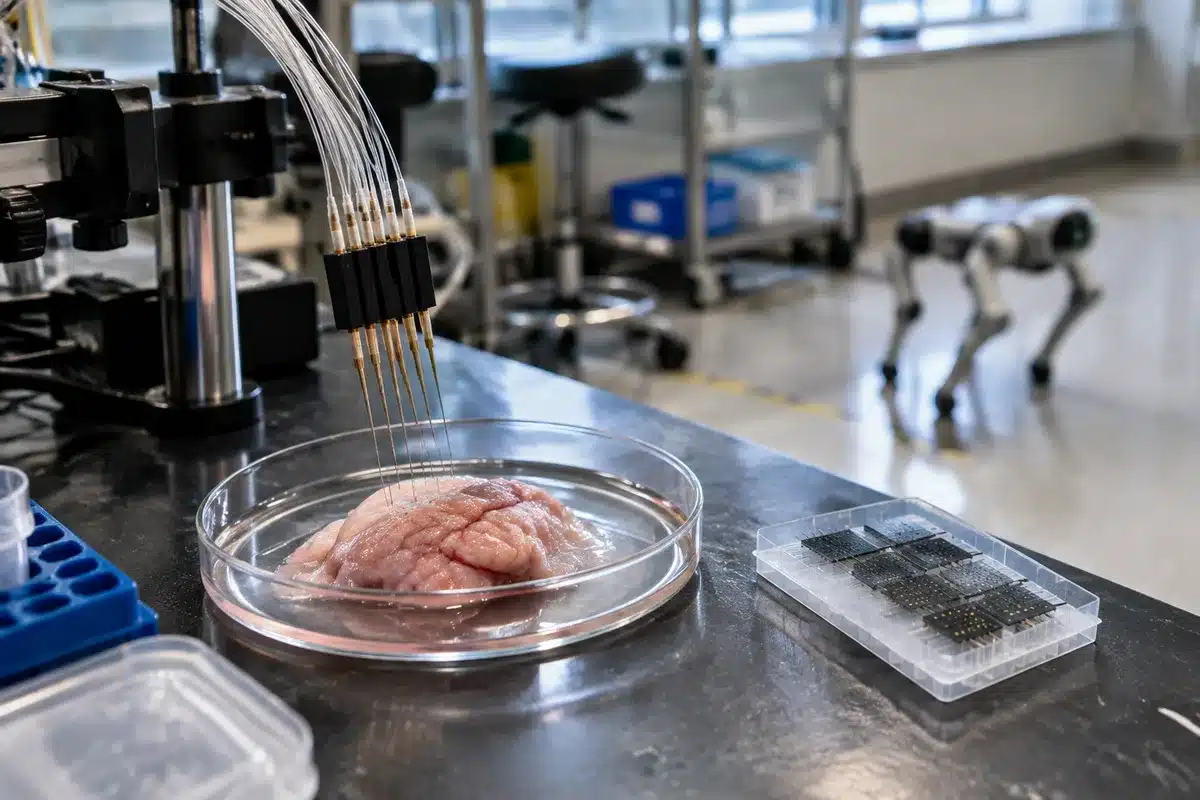
At the University of Bristol, researchers tested millimetre‑scale models of the human forebrain — known as organoids — to see how they respond to tactile patterns. The tissue samples contained roughly 10,000 nerve and support cells and sat on microelectrode arrays that both stimulated the cells and recorded their activity.
Post Salt publishes Bikernet weekly news for August 28, 2026
Lab-grown neural tissue reads Braille and steers robot dogs
A Braille scanner converted raised‑dot characters into electrical stimulation patterns. Those patterns were delivered to the organoids, and a standard machine‑learning classifier analysed the neural responses. From the activity of a single organoid the algorithm picked the correct letter about 61% of the time. Pooling the output of three organoids raised accuracy to roughly 83% and made the system more tolerant of noise introduced by the researchers.
Importantly, the organoids were not trained to read Braille. The experiment used a fixed encoding for the tactile input and relied on a computer algorithm to interpret the recorded activity. Still, the results indicate that living tissue can preserve and transform sensory patterns in ways that remain amenable to classification.
Putting neurons into a learning loop
Other teams are moving beyond passive responses and into closed‑loop setups where cultured neurons interact with an environment. Melbourne‑based Cortical Labs, in collaboration with Honda Research Institute Europe, reported that neural cultures can improve behaviour through experience inside a simulated world.
The researchers implemented what they call an Embodied Neurocomputation Framework. Using Cortical Labs’ CL1 biological computers, they linked living neural networks to a virtual agent navigating a grid. The agent’s goal was to locate a simulated food source by following an odour gradient, choosing to move forward, turn left, or turn right.
Searching the signal space
One core challenge is that neurons do not respond to electrical inputs the way transistors do. Biological responses vary and depend on many internal dynamics. To make interactions reliable, the team systematically explored the space of stimulation parameters.
They tested about 1,300 different signal configurations and collected more than 4,000 hours of real‑time interaction across dozens of biological units. Of those configurations, a dozen consistently produced learning across multiple episodes. Under comparable conditions, those optimized biological setups outperformed conventional reinforcement‑learning baselines on the navigation task.
From wagging robot dogs to real‑world potential
In a separate demonstration, Cortical Labs used firing frequency from a cultured neural network to steer a small robot dog. The behaviour was rudimentary but meaningful: it linked adaptable wetware to actuators, sensors, and control systems in the physical world.

“Robots that are becoming remarkably capable machines at their physical control still struggle with the higher‑order control required to learn quickly or adapt when conditions change,” says Brett Kagan, co‑founder and CEO of Cortical Labs. “Walking, running, and doing acrobatics is amazing, but determining where and when to do actions remains a challenge with traditional methods.”
Why researchers are exploring biohybrid approaches
The attraction of biohybrid computing is twofold. First, neuronal networks operate with very low metabolic power compared with many modern processors. Second, they inherently rewire and adjust through experience — a form of plasticity that could allow systems to adapt without the heavy compute budgets required by large artificial neural networks.
If those qualities can be harnessed reliably, biological components might become the preferred option for systems required to adapt in unpredictable environments where conventional preprogramming falls short.
Hard limits and realistic expectations
Despite promising demonstrations, major practical barriers remain. Keeping cultured tissue alive requires precisely controlled conditions and a steady nutrient supply. All the life‑support equipment consumes energy, so the overall power balance of a working system must be judged end‑to‑end, not only at the level of the neurons.
Researchers are also developing frameworks and benchmarks to measure performance, tune interfaces, and test reproducibility across tasks. The aim is not to replace silicon with pure brain tissue but to determine whether living neural networks can reliably complement conventional electronics.
Where the field might go next
Work to date moves the field beyond demonstration‑stage curiosities. Teams are increasingly focused on systematizing how biological and electronic components interact, and on finding stimulation strategies that produce repeatable learning. That shift is intended to answer a practical question: can living networks deliver consistent, energy‑efficient adaptation in applications where classical approaches struggle?
For now, organoids and cultured networks remain experimental tools. But the combination of novel frameworks, systematic parameter searches, and longer‑duration experiments suggests a clearer path toward practical, if hybrid, computing architectures.