Show summary Hide summary
Around the world, women shoulder far more unpaid domestic work than men, a burden that chips away at income, education and personal freedom. A low-tech washing machine designed for off-grid environments aims to cut that unpaid labor dramatically and expand access to time-saving household tools.
A widespread imbalance, and a practical response
Research by the Centre for Global Development found that, across 50 countries, women spend an average of 29.92 hours per week on domestic tasks while men average just 9.78 hours. The gap has clear consequences: lost earnings, weaker pension prospects, fewer schooling opportunities for girls who often share housework, and less time for work or mobility.
Post Salt Bikernet issues weekly edition for August 28, 2026
Light-powered e-paper display powers wall art without an external charger
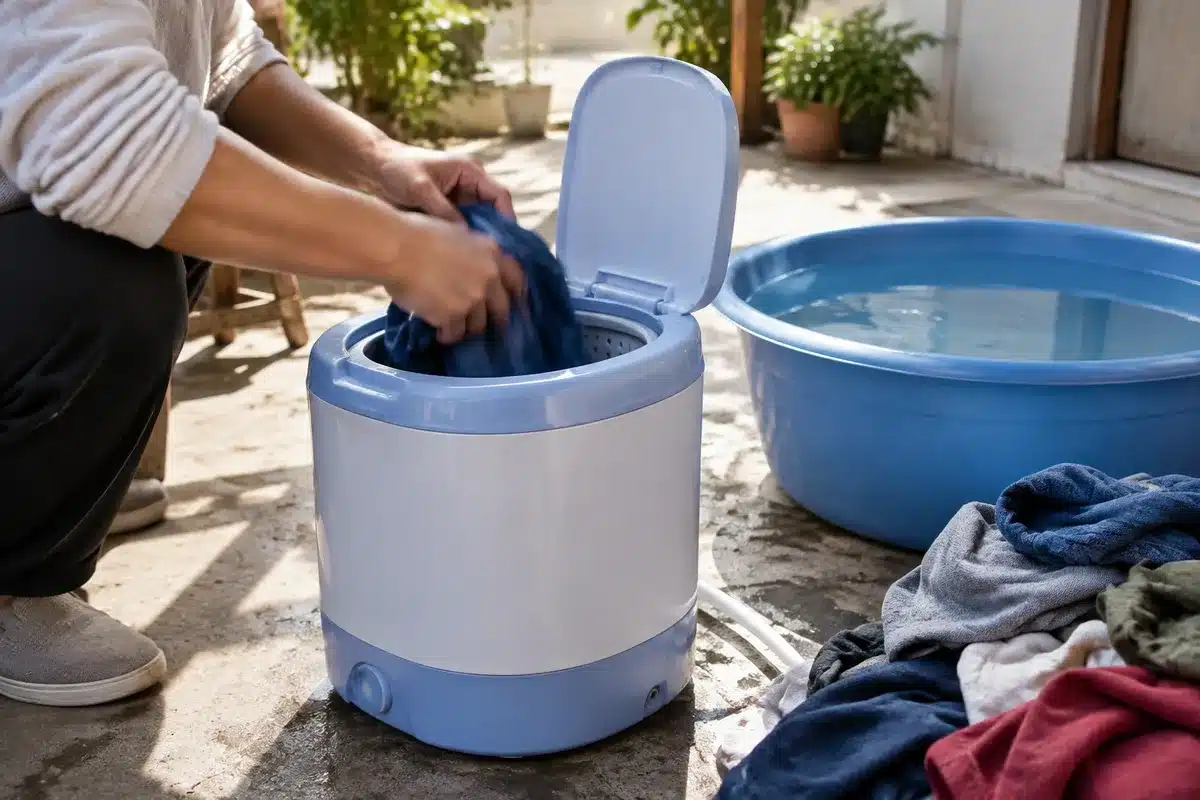
Tools that are dependable, simple to repair and inexpensive can reduce this unpaid drudgery. One such tool is the Divya, a hand-cranked washing drum developed by Navjot Sawhney, an aerospace engineer who previously worked at Dyson UK.
How the Divya works
The Divya is a manually operated washing drum that needs no electricity. It holds up to 7 kg (about 15.4 lb) of laundry and requires roughly 30 liters (7.93 US gallons) of water per use. The company says users can take it apart using just two tools, and that it arrives partially assembled with clear instructions.
The Washing Machine Project reports the analogue device cuts washing time by about 75% compared with hand-scrubbing and halves water use. The unit is designed to be durable for at least five to 10 years under typical conditions. Sawhney named it after the woman who inspired the idea.
Field use and scaling ambitions
Because it operates without power, the Divya is intended for remote, impoverished or disaster-affected communities where electricity is unreliable or unavailable. The Washing Machine Project says the device has already reached roughly 105,000 people across Iraq, Lebanon, Mexico, Uganda and the United States.
The organization plans further expansion, aiming to serve one million users by 2030 through partnerships with humanitarian and development agencies such as the UNHCR, Oxfam and Plan International. “In our humanitarian and partner-funded programs, the machine is provided free to end users,” Sawhney told New Atlas. He added that there is no single retail price for households and that the group also works with organizations buying machines for their programs.
Research-driven design and local needs
To ensure the product fit diverse contexts, the team conducted ethnographic research in 13 countries and interviewed more than 3,000 families. The interviews covered laundry habits in Uganda, Kenya, Iraq, Jordan, Lebanon, Cameroon, Jamaica, Nepal, India and the Philippines, among others.
Design choices and future updates
Some have suggested adapting the Divya to run off pedal power. Sawhney said the project intentionally kept the unit self-contained and portable. “We wanted an electricity-free machine that remains self-contained and portable, without needing a separate bicycle or pedal frame,” he said, adding that the priorities were simplicity, repairability and household usability.
Rather than building a separate appliance, the team is focused on iterative improvements. Planned updates include a built-in scrub surface, a wider opening for bulky items, faster drainage and stronger wheels. The project is also exploring local manufacture, maintenance and shared-access models in India so benefits continue after delivery.
The Washing Machine Project provided the technical and program details cited in this report.