Show summary Hide summary
The Akaso 360 arrives as a lower-cost entry into 360-degree filming for riders, packing dual lenses, horizon stabilization and a generous accessories bundle into a package that undercuts established rivals. Priced around £299.99 for the motorcycle combo (camera-only options start at roughly £220), it aims to deliver most of the popular 360 workflow at a fraction of the usual cost.
What you get and how it feels
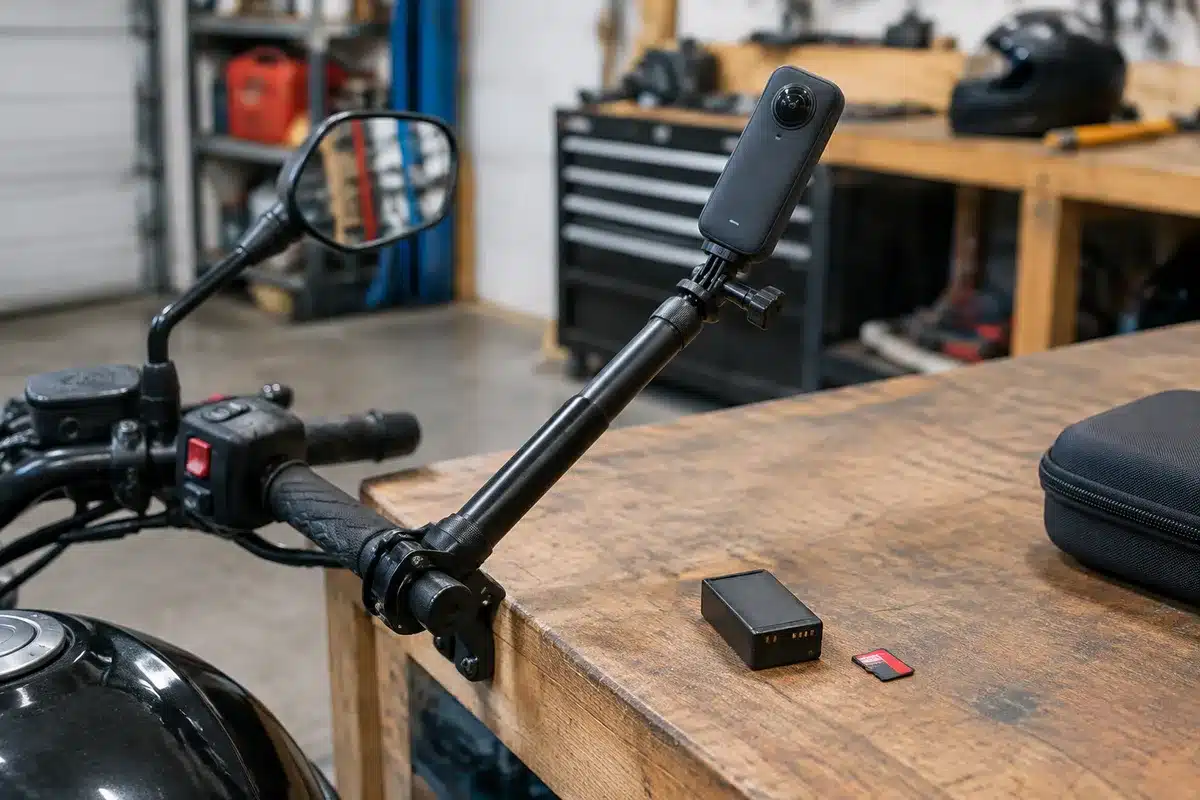
The Motorcycle Combo ships with more than just the camera: two batteries, a 128GB microSD card, a robust selfie stick with twist-lock sections, a pair of strong clamps, a charging cable, lens protector and a soft carry case. The mounts and clamps feel durable rather than toy-like, and the double-clamp arrangement makes bracing an extended selfie stick possible, which reduces vibration when the camera is mounted to a bike.
The unit itself is compact and familiar in shape — similar in size to many consumer 360 cameras. Controls are intuitive and a previous user of 360 rigs will be able to start shooting almost immediately. One friction point: the desktop editing app is not distributed through the Mac App Store; in 2026 it must be downloaded from Akaso’s website, though the mobile app is available in the Apple App Store.
Key specifications
- Dual 1/2-inch CMOS sensors
- 5.7K 360-degree video
- 72MP photo mode
- Horizon Lock and SuperSmooth stabilization
- 2.29-inch touchscreen
- Wi‑Fi and Bluetooth
- MicroSD support up to 512GB
- Claimed battery life up to 120 minutes; measured ~55 minutes per battery
- Splash-resistant (not fully submersible without housing)
- Weight: 180g
Image quality and the editing experience
Footage looks bright and punchy out of the camera, with vivid color that will appeal on phone screens and short social clips. However, image sharpness and fine detail fall short of what you see from higher-end 360 models such as the Insta360 X4 or X5. On large monitors or in high-resolution uploads, that difference becomes noticeable.
Akaso’s reframe tools let you create the dynamic, third-person-style shots that make 360 filming popular. They work well for routine edits, but the software shows strain when you stack many reframe points close together. Expect to spend more time and patience building complex moves than you would in more mature editing ecosystems.
Object tracking exists but is less dependable than the tracking systems in market-leading software. On motorcycles — where subjects and background objects move rapidly — the tracking can lose its target. There is also a visible stitch line between the front and rear lenses that requires conscious positioning when you mount the camera.
Stabilization, exports and performance
Stabilization is a standout strength. The horizon correction and overall stabilization keep footage steady during aggressive riding, and the camera rarely appears to lose its orientation even under rapid direction changes. That makes the Akaso 360 particularly good for riders focused on smooth, watchable clips.

Export settings matter. Using the highest resolution and pushing the bitrate to maximum noticeably improves the final video, but rendering can be slow — exporting a sizeable clip commonly takes 15 to 20 minutes. The extra time pays off in results, but creators should budget for the wait.
Battery life, weather resistance and on-bike use
Battery life is reasonable in practice: while Akaso’s claim of up to 120 minutes is optimistic, the reviewer averaged about 55 minutes per battery. Including two batteries in the box is therefore a practical advantage for longer rides.
Weather protection is limited. The body is splash resistant but is not designed for immersion without a protective case. For motorcyclists, that means caution in rain or heavy spray — many users will avoid exposing the camera to prolonged wet conditions unless they add waterproof housing.
Sound and limitations
Audio recording is a weak point. Built-in microphones are quickly overwhelmed by wind noise when traveling at higher speeds; recordings above roughly 40 mph become dominated by wind, making native audio unsuitable for many motorcycle videos. Creators who require usable on-camera sound will likely record audio separately or use an external microphone solution.
Who the Akaso 360 is for
The Akaso 360 won’t unseat premium 360 cameras for users who require the sharpest image, the best tracking or studio-grade audio. Owners of established models such as the Insta360 X3, X4 or X5 will find little reason to switch.
That said, the Akaso makes 360 filming accessible. For riders who want to experiment with third-person shots, create social reels, or assemble stable, eye-catching footage without spending more than £300 for a bundled kit, it is a sensible, budget-conscious option. It delivers much of the workflow and several useful accessories, trading some polish and image fidelity for a much lower price point.