
Show summary Hide summary
Scientists at Romania’s Extreme Light Infrastructure Nuclear Physics (ELI‑NP) facility used the world’s most powerful laser to create a beam of muons and image an object through two meters of concrete, a step researchers say could expand non‑invasive scanning beyond current limits. The result, reported in a preprint on arXiv, produces grainy but clear muon shadows of lead blocks and highlights a new pathway for dense‑material imaging.
From laser pulse to particle beam
The experiment relied on the ELI‑NP’s 10 petawatt laser, which delivers an extremely intense, short-duration flash of light. That pulse drives electrons to relativistic speeds along electromagnetic waves; when those electrons strike a dense target they generate secondary particles that decay into muons.

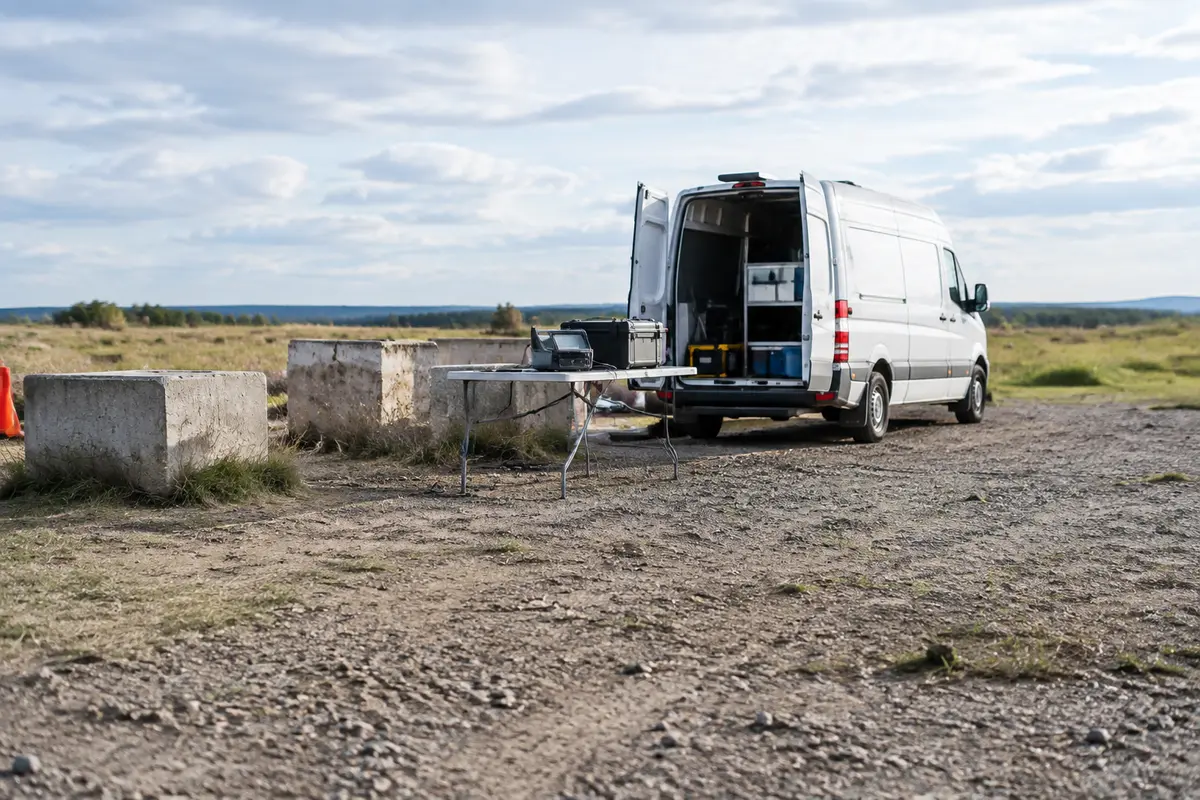
To reduce contamination from other particles, the team built a bespoke filter made of polyethylene sheets wrapped around paraffin blocks. The filtered beam, enriched in muons, was then directed through a two‑meter concrete barrier toward an array of detectors placed inside a van on the far side.
Why muons are useful for deep scanning
Muons are much heavier than electrons and penetrate far deeper into matter than conventional X‑rays. They are produced naturally in the upper atmosphere when high‑energy protons create pions that decay into muons, and those cosmic muons have long been used to probe voids in pyramids and mineral deposits underground.
Artificially producing muons with a laser gives researchers a way to illuminate structures from controlled positions and angles, potentially enabling side‑on imaging and faster data collection than waiting for cosmic muons at naturally low rates—about one muon per square centimeter per second at Earth’s surface.
What the team demonstrated
The detectors recorded the shadow cast by a pile of lead weights inside the experimental setup. While the images lack fine detail, the authors describe the result as the first deliberate muon radiograph generated with a laser source.

The work points toward possibilities for mobile or transportable systems that could one day inspect thick metal hulls, mountain cores, or stone foundations without invasive drilling—though substantial engineering remains before such devices are practical.
How this fits into recent progress
Last year, research groups in China, the United States and the United Kingdom showed that laser‑driven electrons could produce muons, demonstrating the method’s feasibility. An earlier collaboration led by Lawrence Livermore National Laboratory and Colorado State University used similar principles to produce a particle flash that imaged lead weights inside a truck, but details about how many of those particles were muons were not fully reported.
Against that background, the ELI‑NP result strengthens evidence that high‑power lasers can serve as compact muon sources, while leaving open questions about image resolution, beam purity and practical deployment.
The research is available on the preprint server arXiv (Dobre et al., arXiv, 2026), where the authors present experimental details and detector images showing the lead weights next to the van.