
Show summary Hide summary
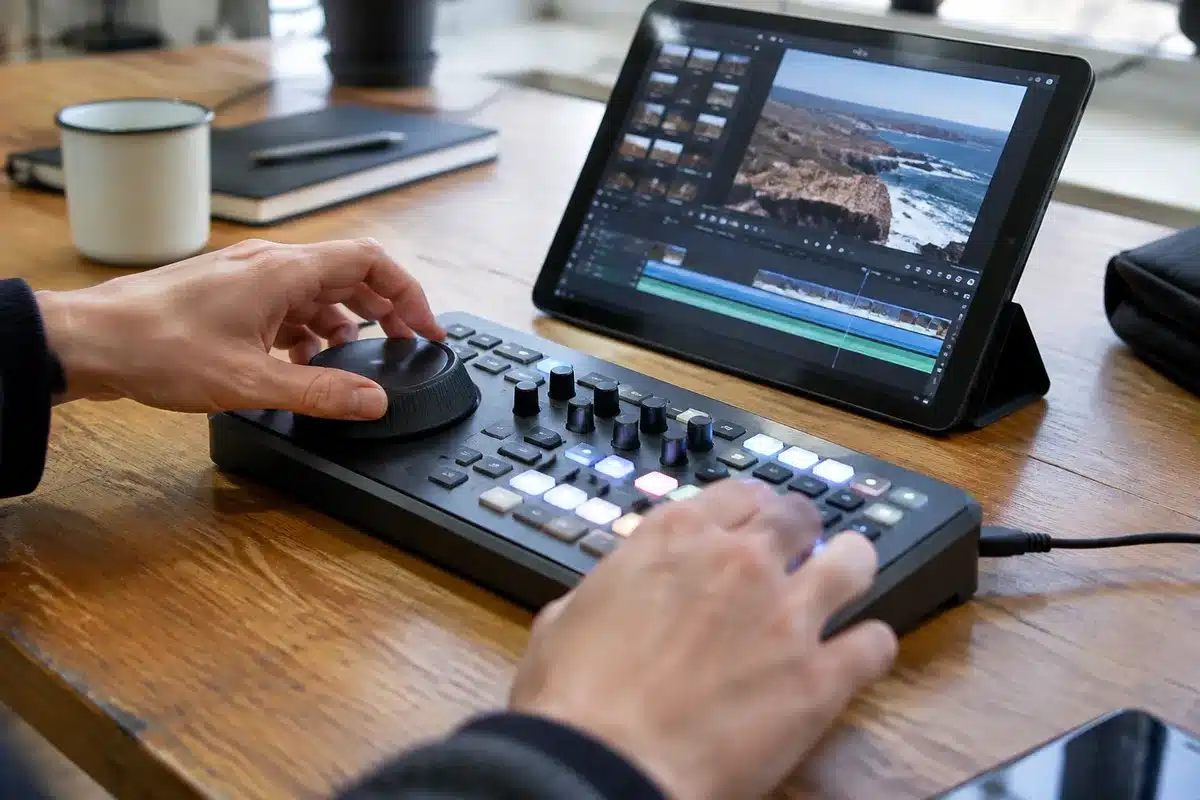
A compact control surface called Benjamin aims to solve a common annoyance for people learning music from video lessons: fiddly touchscreen scrubbing. The device doubles as an iPad stand and gives users tactile controls to set loops, change speed, and navigate media without taking their eyes off the instrument.
How it works
Benjamin uses a simple loop workflow: you press an IN button at the start of a passage and an OUT button at its end. The selected segment begins repeating immediately, and small, dedicated buttons let you nudge the loop boundaries. For fine adjustments you hold IN or OUT while turning the device’s scroll wheel, moving the loop frame by frame.

The same wheel also governs general navigation. It can jump by chapter, skip in 10-, 5-, or 1-second steps, or advance a single video frame. Playback speed changes in 5 percent increments, and one button restores normal speed.
Controls include a row of 13 backlit switches for actions such as play/pause, mute, fullscreen, captions, bookmarks, playlists, and voice search, plus a physical volume slider. A companion app lets users name, save and organize loops and bookmarks into playlists; it plays YouTube inside the app and supports Apple Music and local media stored on the iPad.
Design and compatibility
The unit combines an adjustable iPad cradle with a metal-and-plastic housing. It measures about 280 x 190 x 25 mm (11 x 7.5 x 1 in) and weighs roughly 950 g (2 lb). Connectivity is via Bluetooth LE, and Benjamin works with iPads from the mini up to the 13-inch Pro running iPadOS 16 or later. The cradle can mount on tripods or VESA arms for studio setups.
Battery capacity is 3,200 mAh; the company rates that for approximately nine days assuming three hours of daily use. The team emphasizes tactile operation so musicians can adjust playback by feel while practising.
Launch, pricing and timeline
Benjamin launched on Kickstarter and reached its CAD 10,000 goal in about 15 minutes. Early-backer pledges began at roughly CA$499 (about US$350), while the planned retail price is CAD 699 (about US$490).
This appears to be the first product from Benjamin Industries, a husband-and-wife venture that has added software engineer Erik von Harten to the team. The company says it has filed patents in Canada and the United States and is targeting final testing and certifications by December. Production is forecast to begin in June 2027, with shipping scheduled to follow one month later.
Audience and limits
Rather than trying to teach music directly, Benjamin leans on the enormous catalogue of online lessons and focuses on giving learners precise playback controls. That approach could help not only musicians but also users following dance, sports, or craft tutorials that require repeated, detailed practice.
There are limitations: the device is iPad-only at launch and cannot control the native YouTube app. The company plans to add support for more platforms, and the app does not require a subscription.
Sources: Benjamin Industries, Kickstarter