Show summary Hide summary
Scientists at EPFL say they have found a way to power and steer devices too small to hold batteries or motors by using sound. Their technique converts ambient acoustic energy into directional thrust, a development that could change how micro-robotics and tiny sensors move.
How sound can produce push
The team at the MicroBioRobotic Systems (MICROBS) Lab relies on Helmholtz resonance, the physical effect that makes a bottle sing when air is blown across its opening. When a sound wave excites a hollow chamber, the trapped air oscillates at a preferred frequency and produces a concentrated jet of outgoing flow.

Because the returning air is more diffuse than the outgoing stream, the imbalance generates a net pushing force. In other words, a properly shaped cavity can turn ambient acoustic oscillations into steady thrust without any onboard power source.
Prototypes: boats, microfliers and spinning blades
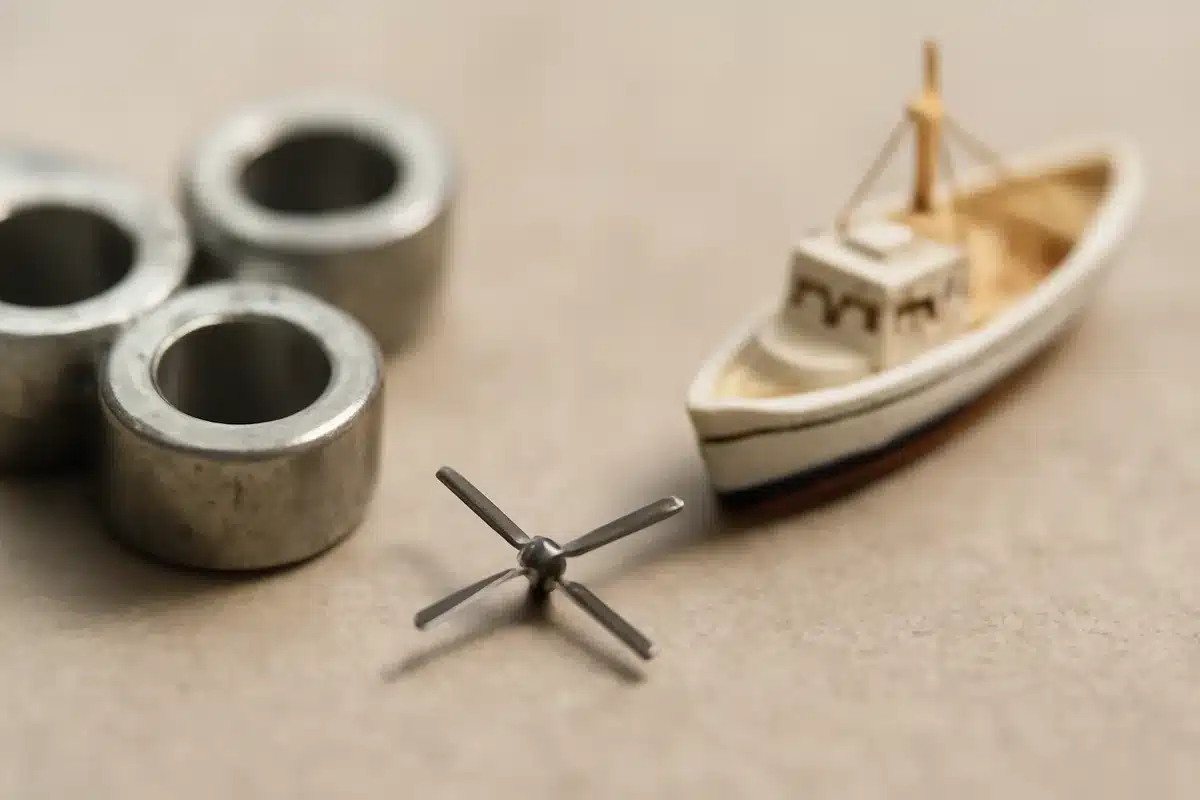
To demonstrate the idea, researchers built several small devices with hollow acoustic cavities. One prototype was a miniature boat fitted with three cavities tuned to different frequencies. By changing the sound frequency, the team could activate a chosen cavity and push the boat in a selected direction.

They also created ultralight flying devices, described as microfliers, that weigh roughly 150 micrograms and carry three microscopic cavities. These microfliers were driven by ultrasonic tones—frequencies above the range of human hearing—and achieved forward motion during tests.
Another configuration paired the cavities with tiny propeller blades. The acoustic jets produced enough torque to spin those blades at about 13,000 revolutions per minute, a speed comparable to or exceeding the rotation rates of many hobbyist drone propellers.
Control, design and implications
Rather than relying on loudspeakers to directly push passive objects, the researchers tuned small acoustic structures to capture and direct sound energy. “Instead of pushing devices around with sound waves, we have created acoustic resonators that are tuned to harness sound at specific frequencies to generate directional thrust and controlled motion,” explains Selman Sakar, head of the MICROBS Lab.
Because cavities can be designed to respond to particular frequencies, different parts of a device can be activated independently by changing the acoustic input. That opens the possibility of flexible systems with multiple sound-responsive elements that move or reconfigure without conventional motors or batteries.
The work points to new approaches for powering micro-scale robots and sensors in environments where carrying a battery is impractical. It also suggests novel ways to couple structures to ambient sound fields for locomotion or actuation at very small scales.