Show summary Hide summary
A Caltech-built robot, funded by DARPA, has assembled a section of an antenna truss in orbit — a step researchers describe as the first autonomous construction of a structure in space. The test shows how many small, launched components could be joined in orbit to create large systems without requiring long human spacewalks.
What the demonstration accomplished
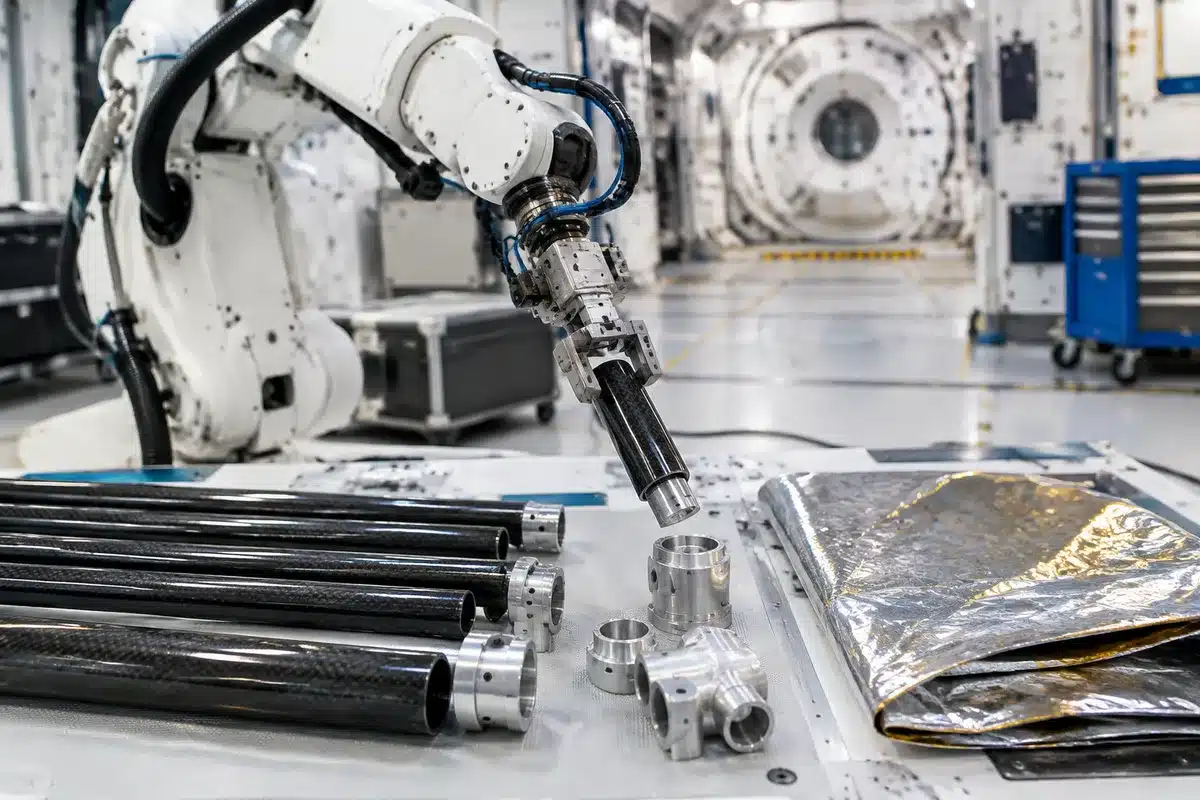
The experiment, part of DARPA’s NOM4D program, tasked the robot with building a support bay for a 1.4-meter-wide (4.6-foot) reflector antenna from a kit of composite tubes, aluminum joints and reflective film. Two truss sections rode to orbit already assembled; the robot added a third, smaller bay during the mission.
A preview of the Alpinestars Tech-Air 5 Plasma’s specs and features
A preview of the 2027 Triumph Street Triple 798 RS

Caltech designed the robotic builder and DARPA funded the space demonstration. Researchers say the achievement represents a practical proof of concept for assembling larger structures piece by piece in orbit.
How the team ran the test
Operational limits constrained the robot to a single support in this flight. Communications were limited to short daily windows, typically about 15 minutes, so engineers on the ground reviewed images and tested fixes on a duplicate rig in the lab before sending new commands.
The program’s ground team cautions that “automated” is not yet fully autonomous in the sense of zero human oversight. Still, the demonstration showed a robotic sequence that can be repeated in space to build up larger structures from simple elements.
Program goals and long-term vision
NOM4D envisions shipping raw materials into orbit and fabricating structures there, rather than launching fully finished hardware designed to survive Earth’s launch environment. The approach could enable antennas, optics and solar arrays tailored to operate only in space.

Andrew Detor, program manager for NOM4D, framed the idea simply: DARPA likens the method to building with Tinkertoys or K’Nex — repeating straightforward steps to create systems far larger than the assembler. “Nothing approaching that scale can be achieved today,” he says.
Detor added that the assembly box combines basic operations in a scalable way: “Within the automated assembly box, each section is built piece by piece, a reflective mesh is attached, and the assembled sections are deployed as they are complete. There are no complicated robotics or advanced algorithms; it’s just solid engineering from the Caltech team to combine operations in a way that scales.”
How this fits into a longer history of orbital manufacturing
Robotic construction in space is not new: Canada’s Canadarm2 helped stitch together large International Space Station modules while astronauts performed on-site installation. Those efforts joined major components manufactured on Earth rather than fabricating them from many small elements in orbit.
There are precedents for on-orbit fabrication too. In 2014, a 3D printer aboard the ISS produced a replacement faceplate for its own extruder, demonstrating the utility of an orbital machine shop. NASA’s Archinaut One project (also known as OSAM-2) pursued a hybrid approach of 3D printing and robotic manipulation to make beams and deploy a solar array, but the program concluded in 2023.
ASTRA’s orbital assembly of a truss bay provides a tangible step toward the NOM4D goal: building larger, mission-optimized structures in space by repeating simple, reliable assembly sequences.