Show summary Hide summary
A catchy commercial shows actor Nick Offerman in a woodshop silencing his buzzing phone — then obliterating it with a hammer. For riders who depend on their devices for navigation, photos and trip tracking, discarding a smartphone is not an option; careful mounting and protection are essential.
Why riders need a reliable phone setup
Motorcyclists increasingly treat their phones as multifunction instruments. Navigation apps such as REVER turn a handset into a primary route guide, while cameras document rides and incident footage. That makes the choice of case and mount more than convenience — it becomes a safety and functionality decision.
Post Salt Bikernet issues weekly edition for August 28, 2026
Light-powered e-paper display powers wall art without an external charger

How the Quad Lock system is built
The Quad Lock platform centers on a two-part approach: a dedicated case and compatible mounts. The case features a firm nylon core and an impact-absorbing TPU outer shell. Its rear section contains the female side of Quad Lock’s dual-stage locking interface, while the exterior uses a soft-touch finish that slips easily into a pocket.
Quad Lock sells an original case and a MAG version. The standard model is positioned at a lower price point, while the MAG case adds a magnetic ring on the back for use with vehicle magnetic mounts. Both variants pair with Quad Lock’s patented Twist, Lock mechanism.
Mount options and materials
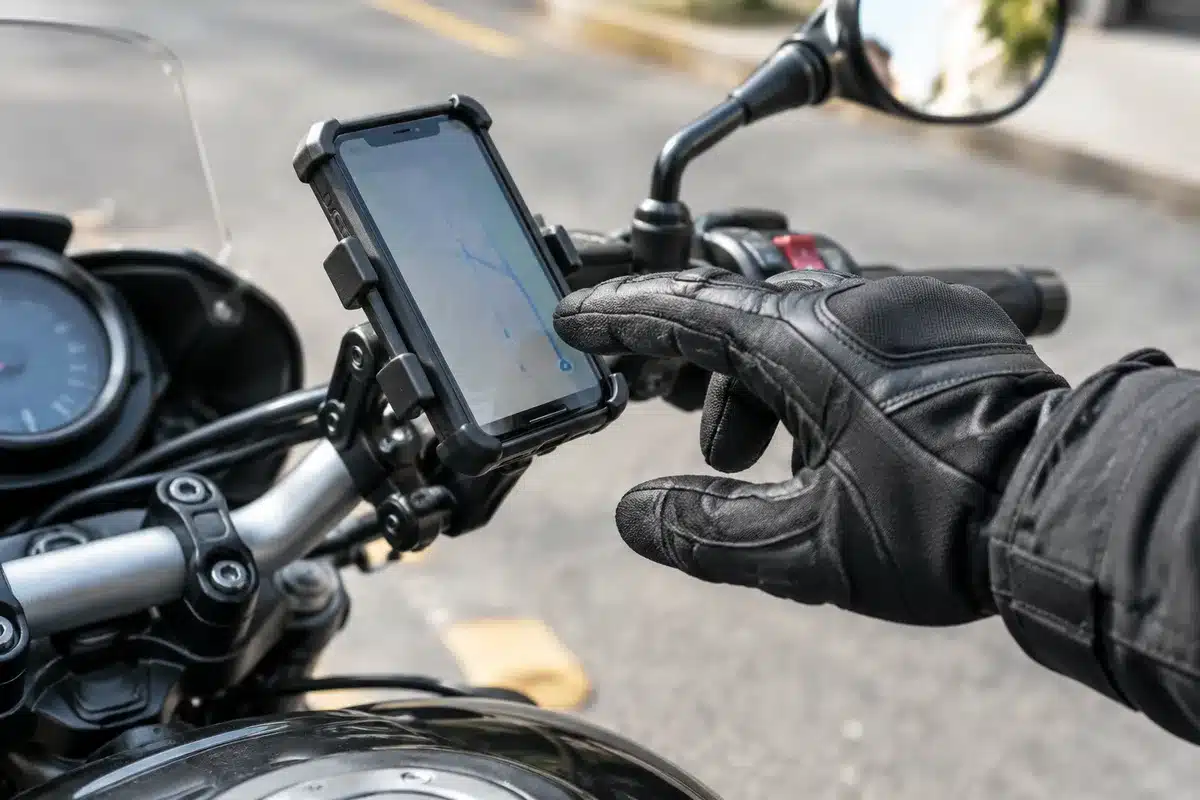
For handlebars, Quad Lock offers a basic clamp made from glass-filled nylon with stainless steel fasteners. A higher-end PRO variant uses black anodized aluminum; there is also a chrome-style version. The mounts include spacers to fit a range of bar diameters — the basic kit covers 22mm through 32mm, and the PRO adds a 35mm option.
Riders should pick the mount that balances weight, durability and fit. Aluminum hardware tends to resist long-term corrosion better than polymer components, but both styles lock the phone in the same twist-and-click pattern.
Vibration: a real risk to phone cameras
Apple warned in 2023 that exposure to high-amplitude vibrations at certain frequencies — notably those produced by high-power motorcycle engines — can harm camera performance. Devices that use optical image stabilization appear particularly vulnerable.

To reduce that risk, Quad Lock offers a dedicated vibration dampener that installs between the mount’s locking plate and the extension arm. The dampener is designed to absorb engine vibrations before they reach the phone, helping protect delicate camera components.
Fitting the mount and using it on the road
Installation is straightforward: position the clamp on a clear section of handlebar, insert the correct spacer, then tighten using the supplied hex wrench. Attach the phone by aligning the case’s tabs with the mount’s slots, then rotate until the lock clicks into place. Releasing the device requires pressing the lever and turning in the opposite direction.
Expect a short learning curve. New users often need a few tries to seat the phone confidently, and to set the screen angle so it remains visible without impeding handlebar movement. Fine adjustments to mount position and tightness will improve visibility and reduce unwanted shifting while riding.
Options and accessories to consider
Beyond handlebar clamps and the vibration dampener, Quad Lock’s ecosystem includes extensions and alternate mount styles to fit different bikes and vehicles. Riders who use magnetic mounts in other vehicles may favor the MAG case, which keeps the same locking compatibility while adding magnetic convenience.
Choosing the right combination depends on the bike, typical riding conditions and how often the phone is removed. For many riders, investing in a purpose-built case, a robust mount and vibration isolation pays off in durability and camera performance.