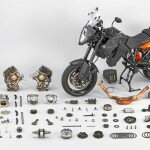
Ducati may be beginning to draw a line under the Panigale with the launch of the new Final Edition version but it remains one of the world’s top superbikes. Motorrad magazine in Germany has put one through toughest test imaginable; 50,000km (31,000 miles) of hard, real-world use. Now it’s stripped that bike down to its individual components to see just how well it fared over the sort of distance that most Panigales will take a lifetime to reach.
 Motorrad has performed its 50,000km tests for years, but there was some trepidation over putting the Panigale through it. Its Superquadro engine lives in some of the toughest conditions imaginable. the massively oversquare engine (112mm bore) revs higher than any comparable design, reaching 11,500rpm and making 195 horsepower in the process. And beyond that it’s asked to act as the bike’s main structural element, with no conventional frame to carry all the stresses of riding.
Even so, Motorrad’s Panigale wasn’t spared the rod. Toured and tracked, it’s achieved the 50,000km moment of truth where we discover just how it’s stood up.
Getting there wasn’t all smooth-running. At the 10,000km mark it started running on one cylinder on cold starts, a fault that wasn’t entirely solved with repairs to an exhaust flap valve. At 24, 150km the bike went back to the workshop, and while the exact cause of the problem was never determined, a replacement wiring loom and lambda sensor eliminated the issue.
There was also a mysterious loss of all the rear brake disk mounting bolts at 30,170km. Ducati could find no explanation for it, and couldn’t find even 10 other cases where the screws had loosened. To its credit, the incident nevertheless resulted in a change in the maintenance regime, so during each inspection the bolts torques are checked.
 Unfortunately, during the investigation in the factory in Bologna, the exhaust pipe bracket on the engine housing was broken by a careless mechanic. Toward the end of the endurance test, this probably led to the rupture of the pipe and its replacement at the 48,000km inspection.
Other than a gear position sensor failure, problems were few and far between during the second half of the 50,000km test. Even the oil only needed a top-up once between 12,000km inspection intervals.
Now for the moment of truth. How does the Panigale stand up after so many hard miles?
A dyno test before its strip-down showed a loss of 8 horsepower, with a fractional drop in torque.
Over the full test, the bike managed an average 7 litres per 100km fuel consumption (UK 40.3mpg, US 33.6mpg). Tyres didn’t last long, with around 4000km for a set of Pirelli Supercorsa SP or Bridgeston S20s. Metzeler Sportex M7 RRs and Dunlop SportSmart 2 managed around 7000km.
The first inspection and the 12,000km service were moderately priced, at just under €300 and €600 respectively. But the 24,000km service came in at a hefty €1500 thanks to the valve clearance check and repairs to a rattling exhaust cover.
At 48,000km the service cost €3300, with around €1000 due to the cracked exhaust. Over and above the normal servicing, the bike had bills for a replacement chain set, front wheel bearing and steering head bearing. The result? A cost-per-km of 20.1 cents, not including fuel or insurance. That’s about twice the per-km cost of a Yamaha R1 under the same test conditions.
 So, how was the engine after all those miles? A strip down revealed that the pistons were unmarked by the marathon, as were the rings. Even the delegation from Ducati was amazed. The minimal scoring on the cylinders was classed as harmless by Ducati, particularly as the dimensions were fine and there was no oil consumption. The camshafts and gudgeon pins were fine, as were the gearbox, oil pump and clutch. There were also no critical marks on the valve seats.
 Nothing gave a clue to where the 8 missing horses had gone. Wear on the con rod bearings and crankshaft was visible but not considered to be of any serious concern by the Ducati technicians. The gearbox shift forks also showed pitting in their DLC coating. One of the three shift fork was worn and needed replacement, and the shift drum, while unmarked, turned rather roughly in its bearing. The valve guides were slightly oval, but all within limits.
All in all, it’s an impressive result for the Panigale, a bike designed to take the V-twin engine to the very limits in terms of power and weight while also adding structure to the chassis. The picture was completed by the very good condition of the bike’s chassis, paint and aluminium parts after three winters of use.
The launch of the Final Edition marks the end of the road for the Panigale. It’s a shame, as this test prove the bike is clearly capable of running for a long time to come.


Photos: Jacek Bilski – bilski-fotografie.de