Show summary Hide summary
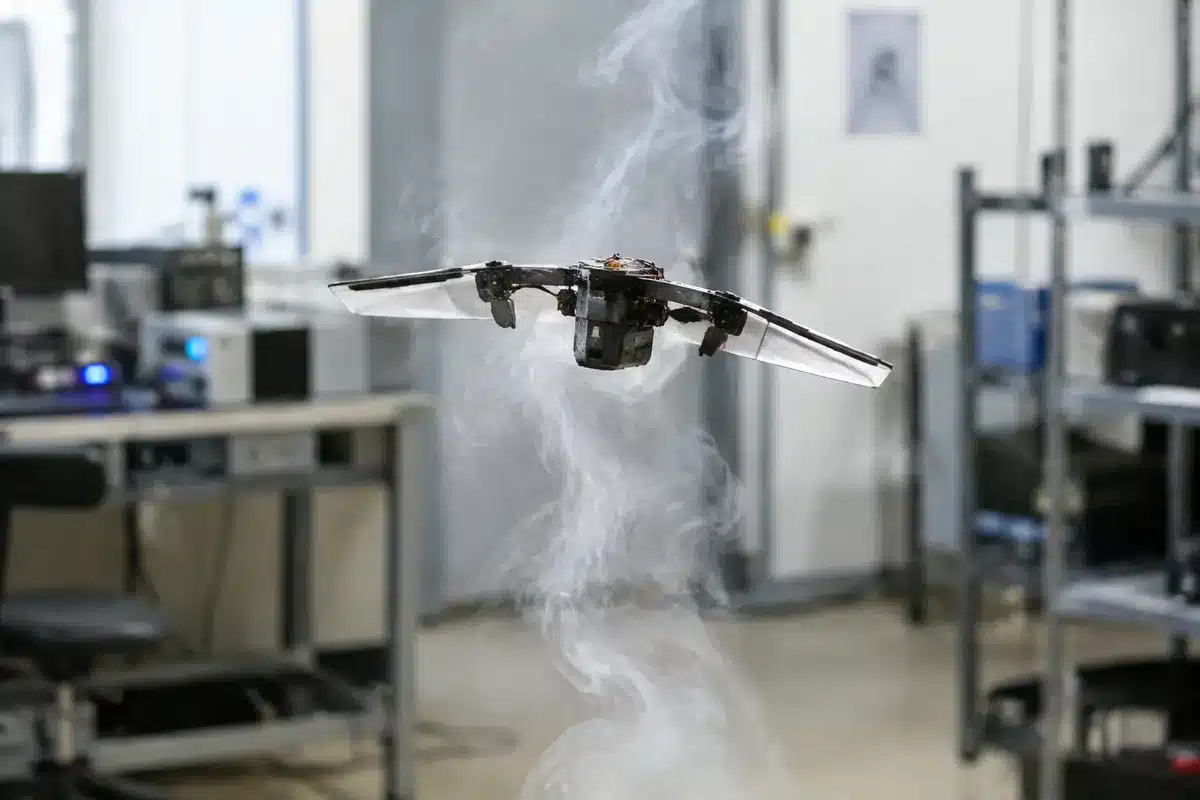
A small research team in Germany has built a hovering robot that conserves energy by riding rising air currents instead of constantly burning power. Called Floaty, the device uses shape-changing wings to exploit updrafts, a strategy borrowed from soaring birds.
How the robot rides the air
Floaty was developed by scientists at the Max Planck Institute for Intelligent Systems together with researchers from the University of Stuttgart. Rather than relying on continuous propeller thrust, the machine is designed to be placed into a vertical column of rising air and then adapt its surface to control airflow.
Honda: will exhibit at London International Motor Show 2027
Loris Baz and Benjamin Smith post their strongest weekend this season

Movable flaps on the craft alter its aerodynamic profile, changing drag to stabilize its position and to move up, down, or sideways within the same air column. That approach allows the robot to maintain station and resist lateral gusts without expending large amounts of battery power.
Tackling stability problems
Early tests with a flatter version revealed a vulnerability: gusts could flip the craft during vertical wind tunnel trials. The team addressed this by lowering Floaty’s center of gravity and introducing a flexible bend into the previously rigid wing flaps.
Those adjustments improved balance and control. In wind tunnel experiments the revised design remained stable at speeds up to 10 meters per second (about 33 feet per second), the researchers report.
Potential uses
The developers say the concept could save energy in situations where sustained upward airflow is available. Prof. Michael Mühlebach of the Max Planck Institute highlighted several possible roles for the robot.
- Inspecting industrial smokestacks and chimneys, where thermal updrafts are common.
- Assisting with atmospheric-science hardware such as weather balloons.
- Conceptual support for vehicles that must manage steep vertical flows, including certain re-entry control scenarios.
“Floaty could inspect factory smokestacks where there is strong upward airflow. It could potentially work there with little modification,” Mühlebach said. “Similar technology could perhaps also help control rockets during re-entry, or it could help guide weather balloons. There are many ways in which the robot can take advantage of upward airflows to save energy.”
Publication and source
The team’s findings appear in the journal npj Robotics. The research and the project details were shared by the Max Planck Institute for Intelligent Systems.