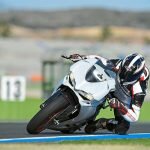
Ducati’s Monster debuted 24 years ago as a simple, air-cooled introduction to the firm’s range and with 2017’s Monster 797 the model is returning to its roots.
When Ducati launched the Scrambler sub-brand in 2014, with the 803cc desmo V-twin, it seemed to spell the end of the line for the entry-level Monster. The air/oil-cooled desmodue Monster 796 powered by the same engine had been replaced in mid-2014 by the Monster 821 with the liquid-cooled, eight-valve 821cc Testastretta motor. So no more minimalist streetfighters of the kind invented by Monster mentor Miguel Angel Galluzzi? Not for a while. But now the air-cooled Monster is back.
 The 2017 Monster 797 is powered by a new Euro 4-compliant version of the 803cc desmodue motor, making it now the only air/oil-cooled model in the Ducati – as opposed to Scrambler – range. Compared to the Euro 8,650 price tag in Italy of the cheapest 803cc Scrambler, the new Monster 797 is available for Euro 8,950 in Ducati red. There’s a Euro 100 supplement for White Silk or Dark Stealth tints. There’s also a Monster 797 Plus version in all three colours for an extra Euro 400, featuring a colour-matched passenger seat cover and flyscreen. All models have extended 12,000 km service intervals.
The Monster 797’s engine is essentially derived from the Monster 796 unit, duly redeveloped to give smoother acceleration and a broader spread of torque throughout the rev range. The camshafts are revised to ensure a linear power delivery. Instead of the twin 45mm throttle bodies on the 796, this engine follows the Scrambler version in having just a single 50mm unit for a more fluid power delivery, but with a separate injector for each cylinder positioned south of the butterfly. The entire intake package is contained within the airbox, which is wrapped within the tubular steel trellis frame to deliver a really slim motorcycle that feels small and agile to ride.
Compared to the 87bhp (64kW) 796 motor, the Euro 4-compliant Monster 797 version has lost 12bhp, delivering a claimed 75 bhp (55kW) at 8,250 rpm. There’s a comparable drop in peak torque from 78Nm to 69Nm (50.8 lb-ft) at 5,750 rpm. This nicely positions the new model beneath the 112 bhp (84kW) Monster 821, making this new bike tailor-made for a different audience of possibly – though surely not exclusively – less experienced riders. The Monster 797 comes devoid of any digital rider aids like traction control, variable riding modes, anti-wheelie or the like, or indeed any other electronics at all beyond the single-stage Bosch 9.1 MP ABS. It’s designed to be a straightforward, accessible introduction to the ducatista experience – light, engaging, simple to use but adequately thrilling, whose appeal comes from that very simplicity. So just hop aboard, turn the key and ride.
 A gloriously sunny early spring day spent hustling the Monster 797 through the streets of Bologna and up into the hills behind the city confirmed this is quite a different bike to the similarly-powered Scrambler. It also arguably looks cooler thanks to the iconic hunched-forward styling, which the new bike embodies in a subtly refreshened way. It has more immediate, sportier steering, which is light and direct without being nervous, and the twin 320mm front discs gripped by Brembo Monoblock M4.32 four-piston radial calipers are stronger than the Scrambler’s single disc. There’s a soft initial bite before coming on strong – exactly what you need for beginners and experts alike. The rear 245mm brake, with its single-piston caliper, is not overly strong but sufficiently potent in use. The package is well able to stop the Monster’s 193kg fully-fuelled wet weight (175kg dry). The price difference between the Monster 797 and the Scrambler is explained straight away with the Monster’s better brakes.
In remapping the ECU to attain Euro 4 compliance for the motor, Ducati’s engineers have dialled out most of the brusque, jerky pickup from a closed throttle in bottom and second gear that mars the Scrambler for many people. Acceleration is still pretty immediate in terms of throttle response, just not so snatchy any more at low speeds. In spite of the reduced power numbers this mini-Monster doesn’t feel at all deficient in performance, thanks mainly to the fact that 80% of its peak torque is delivered by just 3,500 rpm. This means that there’s a clean, responsive throttle roll-on from just 2,000 revs upwards in top gear right until around 8,500rpm in the run-up to the limiter, although because the torque curve is so flat you don’t have to rev the desmodue motor particularly hard. It runs out of grunt at the very top end, but has more than enough midrange punch to bring a smile to your face.
The Monster 797 is just so nice to ride. With the 4,000-7,000rpm rev band its preferred operating zone, you can hold fifth gear for miles on end along a winding road, just surfing the broad waves of torque. 6,000 rpm equals 120kmh/75mph in sixth gear, and that’s a comfortable cruising speed for the Monster 797. There’s no undue vibration – it’s smooth but invigorating, as well as very quiet mechanically, more than I remember the same engine being in the Monster 796. There’s a nice little burble from the 2-1 exhaust exiting behind your right foot, just loud enough to make you smile. Euro 4 regulations may have stifled the sound a little, but the 797 still sounds every bit a Ducati.
 The six-speed gearbox has a flawless action that’s fully up to Japanese quality, and features a cable-operated APTC oil-bath multiplate clutch with a light, precise lever action that makes this an excellent town bike. This has a servo-assisted slipper function that stops you getting the rear wheel skipping if you use a lot of engine braking downhill into a hairpin bend up in the hills. I spent the day chasing round the Appennines in pursuit of Leo Serafino, Ducati’s mileage tester. Fresh back from spending 13 days in France putting 250km on each of the 45 Monster 797 press bikes assigned to the forthcoming riding launch there, he didn’t get sick of riding this bike. “I ride every single model we make quite extensively, including the Supersport bikes,” said Leo, “But even some of my colleagues are surprised how much I enjoy riding this piccolo mostro. It’s just a very honest bike which steers brilliantly, and it’s light and untiring to ride for long distances. It changes direction so well, and the brakes are fantastic, plus it has a very, very low fuel consumption. Many people think of it only as a town bike, to hop from bar to bar on, or to take to the beach. But I enjoy riding it for longer trips like we’re doing today, and the riding position is really great, so comfortable and untiring.”
I can’t argue with any of that, but would add that one reason the Monster 797 is so comfortable is that the footrests are lower and further forward than on the Monster 821. They combine with the one-piece handlebar’s pulled-back grips to deliver a relaxed, upright stance. The 16.5-litre fuel tank is well shaped, so you grasp it cosily with your knees, and the mirrors give a good view and don’t vibe. Coupled with the 805mm seat height – a 20mm lower seat is available as an option – and the way the frame narrows behind the fuel tank it delivers a riding position that feels naturally confidence-inspiring. The new chassis has a 7mm shorter wheelbase at 1435mm, which coupled with a 24º rake and just 90mm of trail for the 43mm non-adjustable Kayaba upside-down fork offering 130mm of travel, helps deliver the agility that Leo was enthusing about. The front suspension is quite firm, but its settings have been well chosen so that it’s adequately compliant with good feedback from the road surface in spite of being non-adjustable. Although the Sachs rear shock is adjustable for preload and rebound, it did give a sometimes harsh ride, especially over successive bumps or ripples in the road surface.
The Pirelli Diablo Rosso II dual-compound tyres fitted are quite grippy enough for the relatively humble power, and combine mileage-enhancing durability with constant grip, say Ducati engineers, even in assertive cornering. They employ Pirelli Enhanced Patch Technology to maximise the contact patch area whatever the lean angle, and Functional Groove Design to optimise performance in the wet. With a 120/70 ZR17 up front and 180/55 ZR17 at the rear, there’s a good compromise between delivering grip and providing the agility that’s such a key feature of the 797’s handling.
Since the removal of the Monster 696 from Ducati’s catalogue, there’s been a clear gap in the Monster range which the Scrambler models don’t really fill. “We see the Monster 797 as appealing to traditional Ducati customers, whereas the Scrambler family is aimed at attracting new riders to our products,” says the 797’s project leader Eugenio Gherardi. He’s right; the 797 eloquently fills this gap as a cool new entry-level Monster for inexperienced riders. It’s accessible, comfortable and easy to ride, a simpler and less intimidating bike than anything else in the Ducati range right now.
 With more than 325,000 Monsters manufactured in the 24 years since the M900 began production in 1993, these have been the lynchpin of the Ducati success story. Without the income and profits generated by successive Monsters, there’d have been no serial World Superbike titles for Ducati nor any MotoGP race effort. These bikes have been Ducati’s cash cow, and even as the Italian marque moves ever upward in terms of performance and specification, with the new generation of V4 Superbikes coming up soon, it needs the humble Monster to keep on clocking up the numbers in the showrooms. After riding the latest version of the family, I‘d say there’s every probability it’ll keep on doing that in this sector of the market. This latest version is an ideal entry-level bike which fulfils its role of being flexible and accessible while providing heaps of fun for more experienced riders, too.
However, in producing this bike I reckon Ducati management has made a nifty problem for themselves, notwithstanding Ing. Gherardi’s rationale. The Monster 797 is such a cool-looking bike with all the traditional appeal of the Monster’s in-yer-face styling and spritely, satisfying performance, that I can’t help thinking it’s going to take sales away from the Scrambler. I mean – look at it: which one would you rather have if there’s just Euro 300 difference between the two in the price tag, in return for which you also get an extra front brake and radial caliper, plus an upside down fork and Monster styling. No contest – is it??
Photos: Milagro/Thomas Maccabelli