


The tough 50,000 km endurance test of MOTORRAD revealed nothing to worry about: While unsophisticated, the Honda CBR 600 F is a rock-solid motorbike with an aura of indestructibility. But was it really that good?
Japanese motor engineers are broadly recognised for their mastery in in-line 4-cylinder powerplant configurations. While seldom the most innovative, they have produced and perfected large series of top-quality machines. And that is especially true for Honda, which laid the foundation for this success story with the legendary CB 750 in 1969. An in-line four cylinder from Honda – hard to go wrong with it.
So why the endurance test then? On the one hand, one must check such stereotypes for accuracy. On the other hand, the Honda CBR 600 F is not a Japanese machine at all. While it was certainly developed in the Far East, the machine was actually built, as its base model the Hornet 600, in the Italian Atessa. Of course, all according to Japanese standards. Among other things, the endurance test should reveal whether these are respected in Europe.
However, this new addition to the endurance test fleet was not exactly welcomed with a thunderous applause. The Honda CBR 600 F appeared at some point and people took deliberate notice thereof. However, even power-spoiled testers gradually learned to appreciate the small sporty all-rounder. The Honda CBR 600 F was put through a gruelling test, driven long and hard at all times. Not surprisingly, our mileage shoot up at a fast clip.
The Honda CBR 600 F proved to be a manageable, undemanding machine, notably practical for everyday use. “Typical Honda: stable, comfortable – it just works” comments Gerhard Eirich of “MOTORRAD Classic”. The managing editor, Harry Humke, praises the Honda CBR 600 F as an “uncomplicated, everyday athlete that delivers loads of fun”.
On the whole, the qualities of the excellent all-rounder Honda CBR 600 F are confirmed; as we put additional kilometres behinds us, however, the logbook saw some less friendly comments. “Elegance becomes boredom”, said tester Andi Bildl. “Colourless BBB” writes “PS” man Rob Glück and thus meant “Bread-and-Butter-Bike”. Colleague Thomas Schmieder differentiated: “it’s like a VW Golf on wheels: practical, unremarkable, sympathetic – but also lacking emotion”.

Steady: While pictures of parked CBR’s were quite popular, the machine was often on the road. Credit: Bilski
Now, whether a machine engages someone at an emotional level is certainly a matter of taste and, therefore, a purely personal assessment. Besides subjective opinions, some objective yet sporadic criticism has been expressed from the first day. While the Honda CBR 600 F never suffered any substantial problems, some of our testers took note of a few minor annoyances.
One bothersome feature, especially in daily short-distance use, is the high idling speed after a cold start, which pushes the Honda CBR 600 F hard into curves during warm-up. “Why does it have to rev up to 2,000 turns after a cold start?” asks Thomas Schmieder. “The neighbours wake up early already”. The era of high-revving gas engines via choke seemed long gone; modern motorcycles with elaborate injection management should master this discipline better.
Among drivers, tourists complained of the lack of luggage storage of the Honda CBR 600 F, and criticised jittery vibrations at medium speeds, which led to permanently numb fingertips at the recommended highway speed. And the somewhat sluggish switch was not quite Honda-like to many testers.
The dash aboard the Honda CBR 600 F also drew unanimous and harsh criticism: Digital displays are generally difficult to read, and this might be an understatement for the traditional Honda tachometer bargraph – it is barely visible in daylight! Even if you manage to do so, the lack of clear scaling makes current rpm figures unreadable. One wonders why Honda still incorporates this impractical bar-display design to numerous models. Although riders can possibly do without current rpm, they can hardly live without current speed, which is hard to read in some light conditions.
While the pale displays of the Honda CBR 600 F are far more visible at night, the glaring high-beam indicator light blinds the driver. Cynics argue that this shines actually brighter than the main beam itself, because the latter scatters its power into nowhere – with tons of stray light in front of the front wheel instead of building a far-reaching cone. Therefore, some colleagues ride permanently in the dark using the low beam.
In the assessment of suspension qualities, it should be noted that the current Honda CBR 600 F (internal abbreviation PC41) is a far cry from the homonymous 2006 model (PC35), and certainly has nothing to do with the current CBR 600 RR (PC40). The PC41 hardy aims to be a super athlete, even if it comes from a sporty in-line four cylinder. Technically, the current Honda CBR 600 F is nothing more than a 600cc Hornet dressed in a sporty cowling, i.e. a cheaper and simpler middle-class all-rounder. According to the manufacturer, this was the only way to provide a cost-effective option.
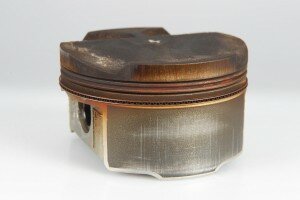
Pistons and cylinders show minimal run marks. The few minor scratches can be safely disregarded; these parts can withstand further use without replacement. Credit: Bilski
This is no doubt a correct strategic measure, because the superbikes market in general – and that of 600 cc in particular – has seen a major downswing in recent years. At Honda, the sales of the double-R fell from around 1,200 machines to just 275 (2012) in five years. This trend also affected Honda Germany’s deliveries of the CBR 600 F, which dropped from 744 units in 2011 to 563 in 2012.
Thus, sports enthusiasts should temper their expectations: there are no racing machines – as was indeed the first Honda CBR 600 F upon launch in 1986 – in the current market. For example, this applies to spring element settings, which prove much simpler today than the complicated parts found in superbikes. On the other hand, this does not put a dent in driving comfort; on the contrary, numerous riders praise the clean response of the upside-down fork. Riders beware: there are less reserves available to accommodate larger loads. Here and there, the fork delivers hard, metal-like blows when driving over edges.
Unless you’re after the best lap time, the little Honda can be a lot of fun on the track. Colleague Eva Breutel whisked the endurance test for the Honda CBR 600 F to a training of MOTORRAD’s action teams on the Nordschleife, and was highly satisfied: “light, handy, tolerant with errors – ideal for rookies”. But whether on a racetrack or a road, good tires always make a difference. And this rings especially true for the Honda CBR 600 F, as it clearly reacts to the tire type and condition. With certain tires, it becomes stubborn and hard to steer, whereas it behaves neutral and precise with others. As for the standard Bridgestone BT 012 tires, they can hardly qualify as the ideal choice, since there are alternatives with better behaviour.

Still unclear why bearing shells in the connecting rod showed unusual washouts. Given their proper wear dimensions, they appear harmless. Credit: Bilski
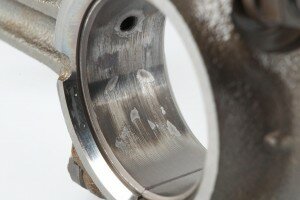
Washouts in the connecting rod bearing shells. Credit: Bilski
Let us now discuss the key strengths of the 600cc four-cylinder engine, namely its reliability and stability. As many anticipated, the machine we put through the endurance test left absolutely nothing to be desired in that respect. We covered the entire 50,000 km without any failures, breakdowns, or defects whatsoever. Not a single unplanned workshop visit. In terms of reliability, the Honda CBR 600 F honoured its reputation.

The front brake pads were worn to different degrees in each calliper. Honda’s composite brake CBS certainly plays a role here, as callipers are applied differently. Credit: Bilski
The higher wear of the brake pads on the left callipers is possibly due to the CBS composite brake of the Honda CBR 600 F. On the other hand, it might also have to do with the somewhat sluggish piston behaviour, which wears down brake pads prematurely. This was noticed by Harry Humke, who at 24,000 km noted as follows: “Brake grinds when pushing”. While the right brake pads were replaced just once, the left ones had to be changed twice. Incidentally, both rear pads were worn unevenly at times.
Maybe the tough conditions were to blame for it. Truth to be told, we did not go easy on the Honda CBR 600 F. It was precisely because of its reliability that is was often out under the worst weather conditions in the cold season. The machine is certainly not to blame for the ignition freezing overnight as temperatures dropped to minus ten degrees, as fleet manager Rainer Froberg noticed. In any case, the problem was quickly solved by heating up the key with a lighter. On any occasion – even after such a frosty night outdoors, the Honda CBR 600 F started without hesitation.

The four-cylinder block, integrated into the upper housing section, appears very compact. Worn cylinder bores would surely ruin the housing too. Credit: Bilski
But how about fabrication? Are there qualitative differences between “Japanese” and “Italian” Hondas? It is challenging to answer such question in a general fashion. In the case of the CBR, no obvious fabrication defects were recognisable. The otherwise outstanding impression was clouded only by continual droning noises from the cowling – its origin remains unknown. Especially around 4000 rpm, where the engine runs quite rough, testers could feel an unpleasant rattling.
First related entries can be found in the logbook right past the 10,000 km marker – no previous mentions. As of today, we ignore whether this droning noises resulted from material aging, assembly errors after inspections, or a harmless accident while parked after 3,750 kilometres. What is more, the cowling did not show a single crack, and had no missing screws or broken noses.
To top it all off, the Honda CBR 600 F still conveyed a rather positive impression after two years with long, harsh winters. Paint and metal surfaces appeared immaculate. Screws and nuts are obviously of impeccable Japanese (or Italian?) quality, as these showed no corrosion, flaking or rust.
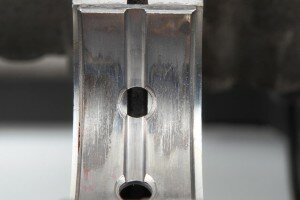
The bearings shells of the crankshaft only show slight run marks; still good for endless hours of safe, enjoyable riding. During reconstruction, however, their renewal is advisable. Credit: Bilski
But how did the engine internals fare? This question must be deferred to the end of the endurance test, when the bike is picked apart at the workshop. Right before, however, the engine and driving performance was measured according to the usual procedure. Surprisingly enough, the test bench showed that the four-cylinder power had not diminished one iota – it picked up a little in fact- after kilometres. Gerry Wagner, the workshop manager, looked puzzled at the compression diagram: All four cylinders showed exactly the same value as that at the beginning of the endurance test, which is an uncommon occurrence.
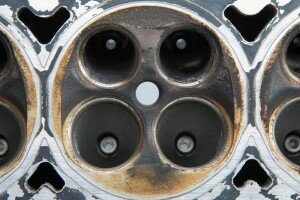
Few fire marks, hardly any oil coal, and narrow valve seats provide a high compression without loss of performance. The small individual cylinder capacity of the four-cylinder engine favours a clean combustion. Credit: Bilski
And this, of course, evidences that the internals of the Honda CBR 600 F survived the 50,000 km in excellent condition. This is especially true for all power-determining parts, i.e. piston / cylinder and valve train. In fact, all of these components presented in perfect condition. Exactly what one would expect from a Japanese four-cylinder machine, even if the engine is built in Italy.
As a minor comment – we noticed superficial erosions on the lower connecting rod bearings – perhaps due to cavitation (bubble formation under high pressure). These are in no way worrisome, especially since the wear dimensions of all bearings lie within the scope of the installation tolerance. Discoloration on the clutch steel disks suggest that the Honda was occasionally taken to the limit. Clutch and gearbox also look fine, and the often sanded shift forks appear in almost new condition. Lacking any material issues, we must pore over such trifles as the rear wheel bearing, which may soon be up for replacement due to its slightly elevated clearance.

Clutch discs are heavily stressed in the test machine; test drives to check driving performance may lead to tarnished steel discs. Credit: Bilski

Close-up of the tarnished clutch disc. Credit: Bilski
Ultimately, all this made the Honda CBR 600 F the new leader in MOTORRAD endurance test statistics. Overall, it is few points ahead of the previous front runner, the Harley-Davidson Road King. The excellent engine stability helps trump the previous winner. Not surprisingly, its contained maintenance costs also make the CBR 600 F the most cost-effective option. This fact, however, has a simple explanation. Unlike older models, this one was on longer service intervals of 12,000 kilometres.
Fuel costs are reasonable; for a mid-size machine, a consumption of 5.8 litres per 100 kilometres is not outstanding. Of course, going full throttle will suck the tank dry fast; the minimum consumption is not record-breaking either.
There is one point, however, where the Honda CBR 600 F cannot hold a candle to the Road King: Its depreciation rate is much higher than the Harley’s. In absolute terms, you’re still better off with Honda’s machine, whose original price – currently under 9000 Euro – is not even half the Harley’s.
Honda takes position

Honda employees Guido Nowak, Jürgen Höpker, and Oliver Franz (in Red v. l.) discuss with MOTORRAD editors. Credit: Bilski
How did the unusual wear pattern on the lower connecting rod bearings came about?
Superficial erosions are certainly harmless and thus not worthy of mention.
Which parts should be replaced now?
The engine could easily take on the same distance again with the same parts.
During a cold start, the motor revs up considerably (2000 / min) – why is that?
The reason lies with the current legislation on exhaust emissions. The increased idle-running regime upon start ensures faster engine and catalyst heating – and thus a shortened cold running phase. Furthermore, the catalyst responds faster.
Test driver complained about vibrations, which led to droning noises from the cowling. Why does the four-cylinder sound so rough?
All Honda four-cylinder in the 600-cubic centimetre range exhibit this behaviour, thus a tendency to vibration is normal. Droning noises, especially from the CBR 600 F cowling, can be eliminated with a kit supplied by Honda. (rubber parts for relining).
The spring elements are a bit lax; the fork, in particular, delivers fast and hard blows at times. Do the chassis of the Honda CBR 600 F and the Hornet differ in any way?
Not at all.
At the end of the endurance tests, the rear wheel bearings showed an increased clearance.
On the one hand, it is essential to understand the weather conditions in which the machine was driven. Driving regularly under rain or in winter leads to faster wheel bearing wear. On the other hand, chains which excessive tension result in higher stress and wear.
Record after 50,000 km
Uncommon consistency: The four-cylinder paints beautiful, equally long lines on the compression meter paper – as if the endurance test never happened.
Cylinder head: While some exhaust valves leak slightly, compression values have not dropped. The valve guides and shafts are in very good condition, as are the camshafts, including bearings. Exhaust valve seats and valves present small fire traces.
Cylinder / piston: Except for a few, harmless friction marks, the cylinder, pistons and piston rings have no signs of wear.
Crankshaft: Connecting rod bearings bear slight cavitation marks. The clearance is nonetheless within the installation tolerance. The crankshaft main bearings exhibit an inconspicuous contact pattern, and the bearing clearance has marginally increased. The piston pin and connecting rod are in good condition too.
Power transmission: Transmission gears and shafts, as well as the switching mechanism hardly show any signs of wear. The clutch steel disks exhibit discoloration but no warping whatsoever. Clutch springs were slightly clogged.
Frame / Chassis: The frame and attachments show the normal marks for the mileage; rocker and steering head bearings move freely, and only the rear wheel bearings show a somewhat higher clearance, which might be an explanation for the uneven (left / right brake calliper) brake pad wear on the front wheel of the Honda CBR 600 F.
Related articles
-
 Honda NC 700 S – Pretty close to indestructibility – endurance test
-
 KTM 1190 Adventure endurance test
-
 BMW R 1200 GS – Cabin fever for the best-selling bike
-
 The Triumph Trophy SE – endurance test
-
 200 HP bikes in the practice test
-
 Ducati 959 Panigale Launch Test
-
 Tamburini T12 Massimo
-
 Yamaha YZF-R1 and BMW S 1000 RR comparison test
